

Written for clinicians, regulatory professionals, and investors. This is not a treatment offer, not a recruitment notice for patients, and contains no claim of efficacy or safety. Nothing here is medical advice.
1. How this started
On 18 August 2026 I wrote to BASG, the Austrian Federal Office for Safety in Health Care, on behalf of Beijing WanBinCell Biotechnology Co., Ltd. The reason was concrete: an Austrian citizen with advanced cancer had contacted us directly, having exhausted standard options. No Austrian physician and no Austrian institution had agreed to anything. I did not ask for permission to treat. I asked four narrow procedural questions about Article 59 of Regulation (EU) 2017/745.
BASG replied in substance. The request is registered under case number 9003909656.
I am publishing the analysis because the answer is useful to more people than me. Every developer of an unnotified device in Europe eventually reaches this question, and most of what circulates about Article 59 is folklore. What follows is the regulator’s actual position, plus a provision of Austrian law that I initially missed and that changes the shape of the problem.
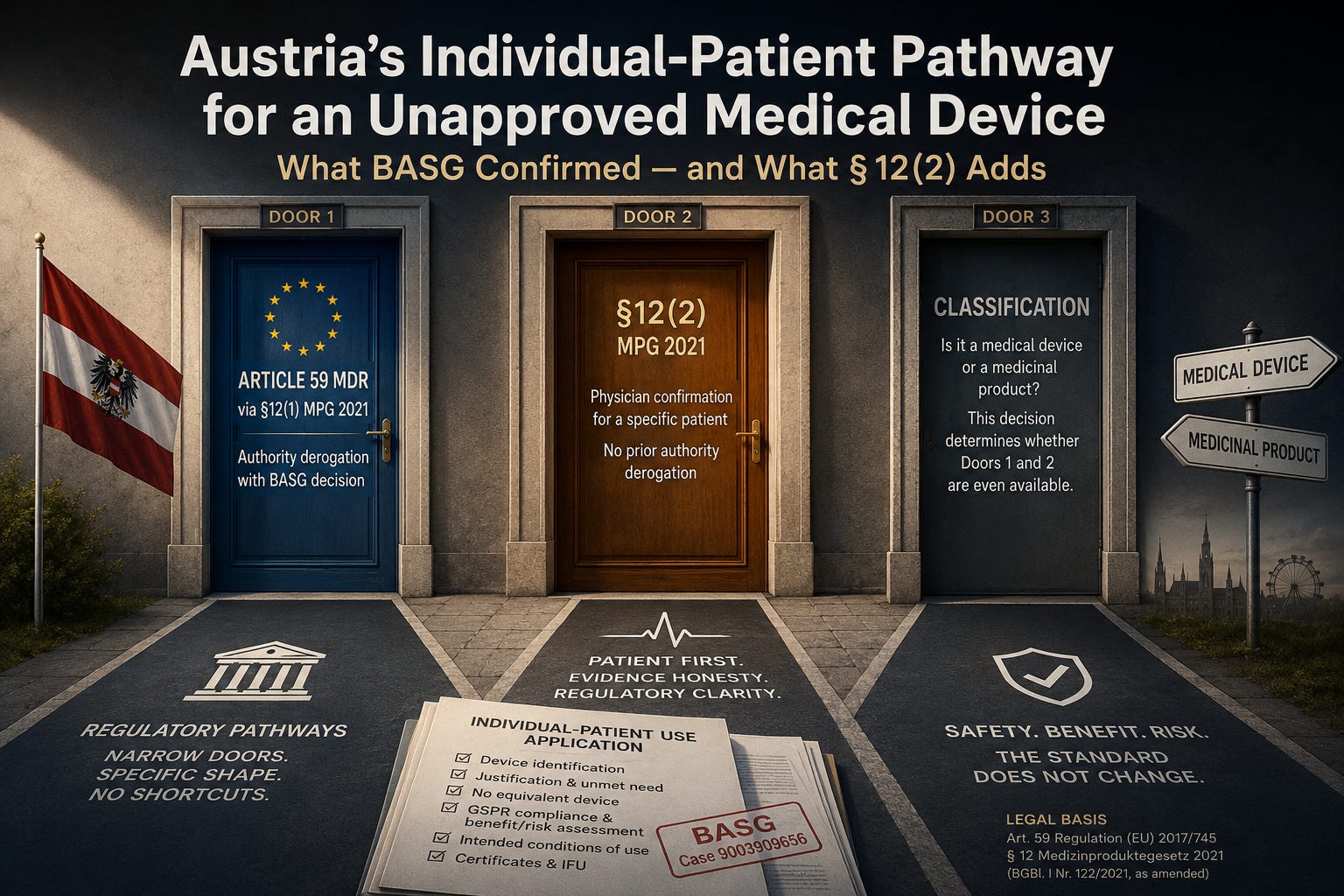
There are three doors. Two of them are procedural. The third one determines whether either of the first two exists at all.
2. Door 1 — Article 59 MDR, via § 12(1) MPG 2021
Article 59 MDR allows a national competent authority, on a duly justified request, to authorise on its territory the placing on the market or putting into service of a specific device for which the conformity assessment procedures under Article 52 have not been carried out, but use of which is in the interest of public health or patient safety or health.
BASG opened its reply by narrowing that, and the narrowing is the most important sentence in the letter. Derogations exist for emergencies in the interest of health protection — not as a way to reach the market early while a clinical investigation or a conformity assessment is still running. And an existing market need, BASG said plainly, is not by itself a sufficiently relevant reason.
That is a real constraint, not boilerplate. It means the case cannot be argued as “this technology is promising and Europe is slow.” It has to be argued as: this patient, this indication, no equivalent certified device available, and here is why using it is defensible anyway.
I state that clearly because I would rather no one read this article and conclude that Article 59 is a shortcut. It is not a shortcut. It is a narrow door with a specific shape, and you either fit the shape or you do not.
What Austria requires — confirmed by BASG in writing. The national implementation is § 12(1) MPG 2021 (Medical Devices Act 2021, BGBl. I Nr. 122/2021, as amended). The procedure begins when BASG receives the signed application form F_I260 and ends with a formal decision (Bescheid). The application must contain:
The exact designation of the device, including any accessories.
Justification of the extent to which use of the device is warranted in the interest of health protection.
Evidence that no equivalent device with a completed conformity assessment is available.
Confirmation of compliance with the applicable essential safety and performance requirements (Annex I GSPRs) for the intended purpose. Where certain requirements are not fully met: a detailed benefit/risk assessment showing that use is nevertheless appropriate, and the measures taken to protect patients, users and, where applicable, third parties.
The intended conditions of use — indications, healthcare facilities, special precautions, duration of use.
Any existing MDR or MDD certificates, plus further device information such as the IFU.
Documents should be in German where possible; English is accepted, particularly for the device documentation itself. The decision is issued in German. BASG stated in its response that processing is currently charged at €203 per hour under its fee regulation; anyone else applying should confirm the rate applicable on the day of their own application, since the tariff is set by regulation and is revised.
Two points this settles that are commonly misunderstood:
For the Article 59 procedure itself, no EC Representative is needed. BASG confirmed that a Chinese manufacturer is not required to appoint an EU authorised representative in order to submit and pursue an Article 59 derogation application. This matches what ANSM in France told us. It should not be read as dispensing with the authorised-representative obligations that apply to ordinary MDR market access — those are a separate question and they do not go away.
The manufacturer can initiate. BASG addressed the substance to us as the manufacturer, not to a hypothetical Austrian sponsor.
Where I am inferring rather than reporting. Because § 12(1) requires the intended healthcare facility to be identified, my practical reading is that a concrete Austrian institution, and a physician who will take clinical responsibility, will ordinarily be needed before an application is complete. BASG never says “find a doctor first.” I asked that question directly and the answer came back as a documentation requirement rather than a yes or no. I treat it as a yes, but it is my reading, not the regulator’s words.
The two items that carry the case. Of the six, two are likely to carry particular substantive weight in the clinical justification — which is not to say the others are formalities. For a high-risk, invasive, uncertified device, the GSPR file, the intended setting, the risk controls and the IFU can each be decisive on their own.
The absence of an equivalent certified device. This is not a claim of superiority. It is a claim about availability of an equivalent, assessed against a specific clinical situation. It has to be built patient-specifically, in the language of what is actually available to that person in Austria — not in the language of what the technology can do.
The benefit/risk assessment under partial non-compliance. This is the clause that makes Article 59 usable for an unnotified device at all. It requires being explicit about which GSPRs are met, which are not, and what compensating controls exist. Vagueness here reads as concealment, and correctly so.
3. Door 2 — § 12(2) MPG 2021, and what it actually does
Austria has a second individual-patient provision that reading Article 59 alone does not reveal. § 12(2) MPG 2021 provides that a derogation under Article 59 MDR (or Article 54 IVDR) is not required where a physician or dentist authorised to practise independently in Austria confirms that:
a medical device is necessary for a specific patient,
to avert danger to life or serious impairment of health, and
treatment success cannot be expected to be achieved with a device for which conformity assessment procedures have already been carried out.
That is genuinely significant, and I wrote about Austria once without it. It is worth knowing about, and worth knowing precisely, because the first-glance reading of it is wrong in several ways.
3.1 It removes an approval requirement, not compliance
§ 12(2) does not confer a CE mark, does not perform a conformity assessment, and does not switch off the rest of the Act. § 5(1) MPG 2021 continues to prohibit applying a device where there is justified suspicion that it does not meet the Annex I essential safety and performance requirements. Under § 38 MPG 2021, health institutions and persons who use or operate devices professionally remain subject to BASG supervision in respect of use, storage, transport and further making available. Vigilance and incident reporting obligations continue to apply.
So it is not accurate to say there is no regulator in the loop. What is accurate is narrower: under Door 2 there is no prior BASG derogation decision and no Bescheid to rely on. The physician’s statutory confirmation becomes the central legal document supporting the individual-patient use, while the ordinary supervision and safety obligations under MPG 2021 remain fully in place.
3.2 Does it also cover the manufacturer’s supply? My reading: yes — and the residual problem lies elsewhere
This is the question a non-EU manufacturer has to answer before relying on § 12(2), and I will give my own answer rather than parking it.
The provision is drafted from the physician’s side. What it does not say in terms is what covers the manufacturer’s act of supplying an uncertified device into Austria for that use. Article 5(1) MDR prohibits placing a non-conforming device on the market, and Article 59 is the instrument that lifts that prohibition.
Three things point the same way:
The grammatical subject is the authorisation, not the physician. The sentence does not say the physician needs no authorisation. It says the Ausnahmegenehmigung is not required when the stated conditions are met. The legal effect attaches to the situation, not to a person within it.
What an Article 59 derogation authorises is precisely placing on the market and putting into service. Those are the manufacturer-side act and the use-side act together. A national rule stating that such an authorisation is not required, while leaving the placing on the market unlawful, would be self-defeating: the physician cannot use a device that cannot lawfully reach them, and § 12(2) would have no operative content at all.
The legislative materials treat it as a case-based carve-out, not a personal defence. The committee report describes the exemption as not required for certain defence-related situations and in the course of medical treatment to avert danger to life or serious impairment of health — the same structure as the predecessor provision in the old MPG.
Reading these together, I take it as the substantially better-supported view — my own weighting, roughly four-to-one — that § 12(2) is intended to make the entire individual-patient use legally operable without a separate Article 59 derogation, supply included. The narrower reading, that the text addresses the physician’s use decision and leaves the manufacturer’s position implicit, is possible but has to explain why the legislature would create a provision that cannot function.
The residual anomaly is a different one, and it is more interesting. Article 59 MDR contemplates an authority decision on a duly justified request. § 12(2) creates a self-executing national exemption with no authority involvement at all. That is where the construct sits least comfortably with EU law — not in the manufacturer-versus-physician split. I flag it as an open point rather than a settled one; it has, to my knowledge, not been tested.
What follows practically. Two things, and they are the reason this section matters more than the legal argument does:
Because there is no authority decision, the entire evidentiary burden is retrospective. If the use is later questioned — as happens when someone files a complaint, which is exactly what happened to a German clinic that used this method in 2025 — the physician and the manufacturer have to demonstrate afterwards that all three statutory conditions were satisfied at the time. So the confirmation should be written, dated before treatment, and address each of the three elements explicitly rather than by implication. The statute does not require that. Reality does.
The supply chain should be as short as possible: manufacturer direct to the treating physician or institution. Interposing an Austrian distributor imports an economic operator whose MDR Article 14 verification duties cannot be satisfied for a device that carries no CE marking.
3.3 Procedurally more permissive, institutionally harder
Here is the part that inverts the intuition. Under Door 1 you end up with a file number, an assessment, and a decision from the federal authority. Under Door 2 you end up with a physician’s confirmation and nothing to put in front of a hospital’s legal department, an insurer, or a medical board.
For a hospital governance committee, the version with a formal authority decision is far easier to approve. In practice § 12(2) may be harder to use institutionally, even though it is procedurally more permissive — and a manufacturer who needs an Austrian institution to say yes is probably better served by the door that generates paper.
There is one exception where the ordering reverses: genuine time pressure. Door 1 takes as long as an assessment takes. Door 2 takes as long as it takes one qualified physician to reach a documented conclusion. If a patient does not have the former interval available, that is what § 12(2) is for, and that is a legitimate reason to use it.
3.4 One caution for anyone thinking about a series
A single individual treatment attempt under § 12(2) is not a clinical investigation. But repeated, protocol-driven use with systematic prospective data collection may cross the line into one, depending on its purpose and design. If it does, and the required approval or notification is absent, § 34 MPG 2021 attaches unusually severe consequences to the resulting data: it may not be published, may not be passed to third parties, and may not be used in a conformity assessment or authorisation procedure — and results already published must be withdrawn.
§ 12(2) is a route to treating one patient. It is not a back route to building an evidence package, and using it that way risks destroying the value of the data collected.
4. Door 3 — the one that decides whether Doors 1 and 2 exist
Both of the above presuppose the same thing: that the product is a medical device.
My letter described an image-guided intratumoral chemical ablation system, consisting of a standardised ablation agent supplied by the manufacturer and delivered by a physician under real-time imaging guidance. BASG answered entirely within the medical device framework and said nothing about whether the product is a device at all.
I do not read that silence as agreement. Under Article 2(1) MDR, an article qualifies as a medical device only if its principal intended action is not achieved by pharmacological, immunological or metabolic means. If a competent authority takes the view that the principal mode of action here is pharmacological, the whole analysis sits under the wrong regulation, and the default rule in Article 2(2) of Directive 2001/83/EC resolves doubt in favour of medicinal product status. Then both Austrian doors close and a different set opens instead.
The honest position: classification is the load-bearing uncertainty in every European pathway I am pursuing — Austria, Germany (§ 7(1) MPDG, BfArM), France (ANSM), Italy (D.Lgs. 137/2022 Art. 11). No regulator has confirmed it in writing. Anyone evaluating this should treat it as unresolved rather than as a technicality that will sort itself out.
5. Where the evidence actually stands
A physician being asked to consider clinical responsibility deserves the real inventory, not a highlight reel.
Peer review: a manuscript reporting ex vivo porcine liver, murine, and veterinary observations of a spatially bounded ablation zone is under review at the Journal of Vascular and Interventional Radiology (JVIR-D-26-01073). It has passed editorial screening. It is not accepted. It makes no efficacy or safety claim.
Preclinical: animal work is public as a preprint (DOI 10.1101/2023.11.24.568512). Whole-blood reaction studies show the reaction forms within one minute and does not expand out to 60 minutes, which supports rapid self-limitation and nothing beyond that.
Human experience: approximately 25 exploratory human cases have been treated in physician-led settings in several countries. The dataset is uncontrolled, retrospective and heterogeneous, without predefined endpoints, independent adjudication, or central imaging review. It is treated here as exploratory clinical experience, not as evidence of efficacy. Case-level outcome data sits in the technical dossier and is available to a clinician or institution evaluating the file; it is deliberately not the headline of a regulatory article.
No approval anywhere. No MDR certificate, no FDA clearance or approval. An FDA orphan drug designation request for recurrent glioblastoma is pending. A US pre-IND package is in preparation.
A German clinic that used the method was ordered by health authorities to stop in 2025, because no authorisation covered it. I mention this deliberately. It is precisely why I am now approaching Europe from the regulatory side first, in writing, with a case number, rather than from the clinic side.
6. What I am asking Austrian physicians for
Not to treat anyone. Not on the basis of this article, and not yet.
What is missing is one qualified Austrian physician or institution willing to read the technical file and decide whether this is worth the next conversation. The profile that fits:
Interventional radiology, interventional oncology, or a surgical oncology setting with routine image-guided percutaneous injection experience (ultrasound and/or CT).
Access to an institution that could plausibly host a single named-patient use, with the associated governance route.
Willingness to hold clinical responsibility if and only if the technical file, the risk analysis and the benefit/risk argument survive your own scrutiny.
What I provide: the full technical documentation, intended purpose and mechanism, the risk management file, the imaging-based dosing protocol, the complete non-clinical dataset, the honest version of the clinical experience above, and the entire regulatory correspondence including BASG’s letter. I carry the application work and the fees.
What I ask you to bring: scepticism, and the willingness to tell me the file is not good enough if it is not.
7. What would stop this
For symmetry, the outcomes that would end this pathway rather than advance it: a determination that the principal mode of action is pharmacological, which removes the product from MDR entirely; an assessment that equivalent certified options remain available to the patient in question; a benefit/risk file judged insufficient against the unmet GSPRs; or simply no Austrian institution willing to take it on.
Any of those is a real outcome. I would rather learn it in writing from a regulator than by assuming.
If you are an Austrian physician, or you know one who would read the file rather than the headline, I would like to hear from you.
Xuewu Liu Beijing WanBinCell Biotechnology Co., Ltd. liuxuewu@wanbincell.com
Legal basis discussed: Art. 59 Regulation (EU) 2017/745; § 12 Medizinproduktegesetz 2021 (BGBl. I Nr. 122/2021, as amended, most recently BGBl. I Nr. 50/2025). BASG case reference 9003909656. Statutory text should be verified against the consolidated version in the Austrian RIS. This is a manufacturer’s analysis of its own correspondence and of the applicable law; it is not legal advice.