
Beyond Reductionism: The Methodological Vacuum of Complex Systems and the Meta-Rule Position of PPI

1. After Lorenz: The Fundamental Division of Scientific Problems
In 1963, meteorologist Edward Lorenz discovered deterministic chaos in a simplified set of atmospheric convection equations: a system fully described by deterministic equations could be extremely sensitive to initial conditions, with long-term trajectories rapidly diverging in real-world prediction. The true significance of this discovery was not limited to meteorology. It lay in the classification of scientific problems themselves.
Before Lorenz, scientific problems, despite vast differences in difficulty, were often assumed to share a unified nature: the search for exact solutions. Particle motion, planetary orbits, chemical reaction rates, electrical circuit responses — all of these problems were assumed, in principle, to be predictable if the equations were correct enough and the measurements precise enough.
After Lorenz, scientific problems were divided into two fundamentally different types:
Simple-system problems: limited variables, clear relationships, controllable sensitivity to initial conditions, long-term predictability, repeatable experiments, and reducible solutions.
Complex-system problems: multiple elements, nonlinear coupling, nested feedback loops, sensitivity to initial conditions, long-term unpredictability, hierarchical emergence, and processes that cannot be strictly repeated.
A complex system is not merely a “more complicated simple system.” It is a different class of problem. Its unpredictability does not simply arise because we are not smart enough or have not calculated carefully enough. It arises from the nonlinear feedback structure of the system itself. Even if the equations are known and the parameters are measurable, as long as the initial conditions cannot be infinitely precise, long-term trajectories will rapidly diverge in real-world prediction.
This is an epistemological watershed. After Lorenz, anyone dealing with complex-system problems must recognize that the methods used for simple systems cannot be directly transplanted into complex systems.
The most widely accepted definition of a complex system is this: a complex system is a system composed of many interacting components, whose relationships involve nonlinearity, feedback mechanisms, hierarchical structure, and dynamic evolution, so that the whole system exhibits properties that cannot be found in any individual component alone.
In other words, the core feature of a complex system is not simply that it contains “many parts,” but that:
The whole is greater than the sum of its parts.
This is not a literary metaphor. It is the basic meaning of “emergence” in complexity science. Emergence means that a system as a whole produces properties that cannot be understood by examining each component in isolation.
A single neuron has no consciousness, but a large network of neurons can produce cognition. A single market participant makes only local decisions, but many interacting participants can generate prices, bubbles, and crises. A single immune cell has only local functions, but the immune system as a whole can produce inflammation, tolerance, autoimmunity, or anti-tumor responses.
Therefore, a complex system contains at least four core elements.
First, multiple agents or variables. The system is composed of many parts, and no single part can represent the whole.
Second, nonlinear interaction. Cause and effect are not simply proportional. A small change may produce a large consequence, while a large input may produce almost no effect.
Third, feedback mechanisms. The output of the system feeds back into the input, causing the system to adjust, amplify, suppress, or deviate from its previous path.
Fourth, emergent properties. The whole system produces new properties that do not exist at the level of isolated parts. This is the real meaning of “the whole is greater than the sum of its parts.”
Weather systems, climate systems, the human immune system, tumor microenvironments, ecosystems, economic systems, financial markets, administrative systems, international relations, and large language model systems are all typical complex systems.
A complex system is not a mess. It is not completely incomprehensible, nor is it completely unpredictable. Its key feature is this:
Different levels of the system have different degrees of predictability.
At smaller-scale levels, there are more variables, stronger feedback loops, and greater divergence. At larger-scale levels, the system is often constrained by more stable structures and therefore more likely to display regularity.
This is the real lesson of complex systems research: the world is not a simple linear machine, but neither is it pure chaos. It is layered, coupled, dynamic, and bounded.
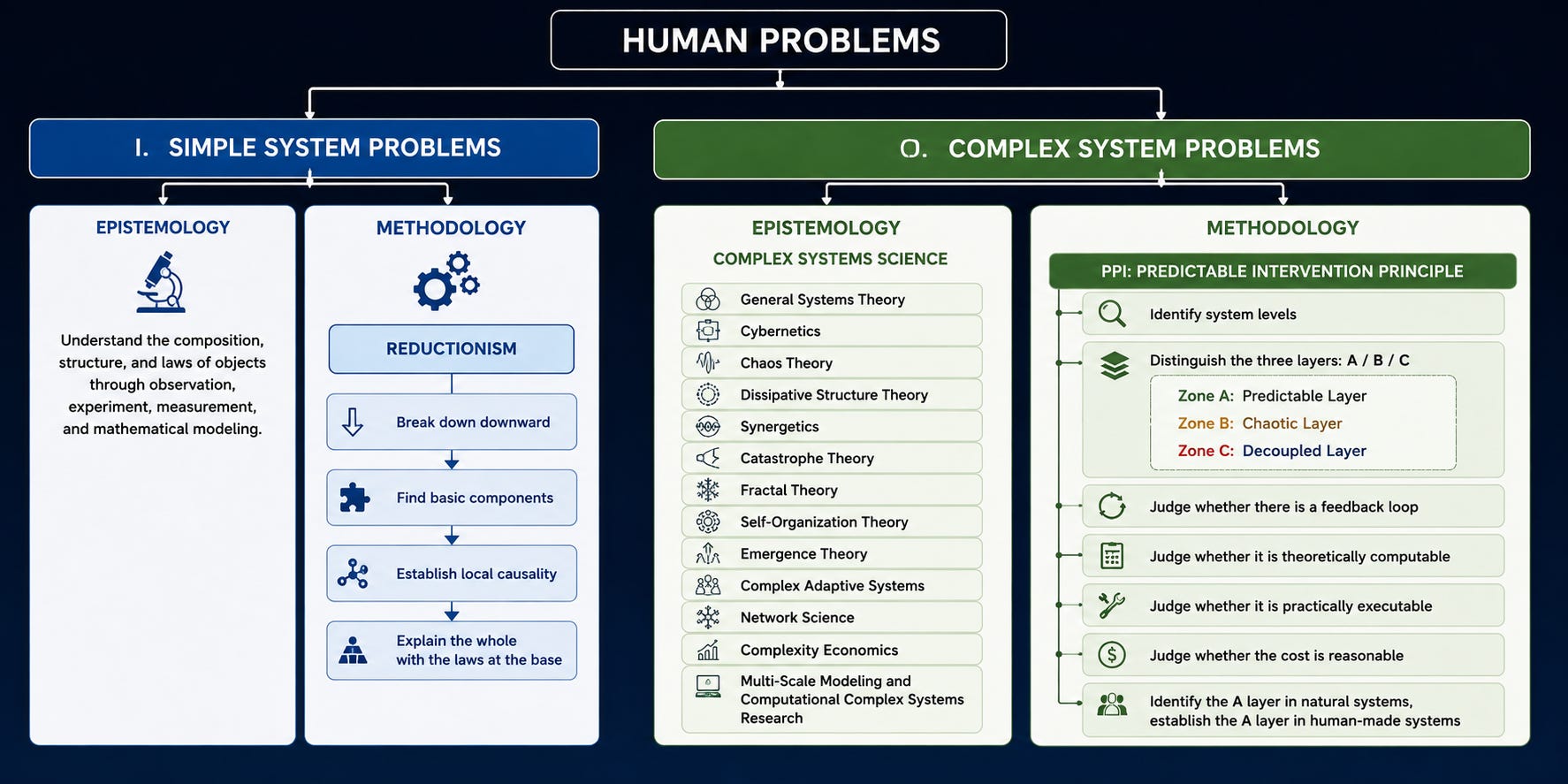
2. Reductionism: The Meta-Methodology of the Simple-System Era
From Descartes’ instruction to divide difficult problems into smaller parts, to the empirical victory of Newtonian mechanics, and then to the downward movement of chemistry, molecular biology, and neuroscience in the nineteenth and twentieth centuries, reductionism established itself as the meta-methodology of science through roughly three centuries of practical achievement.
Its methodological core is extremely clear and can be condensed into three statements:
Break the system down into more basic units.
Establish deterministic laws at the level of those more basic units.
Reconstruct system behavior from the bottom up.
The legitimacy of reductionism was not won through philosophical debate. It was won through engineering results. Steam engines, internal combustion engines, antibiotics, semiconductors, rockets, nuclear power — all of these are victories of reductionist methodology in simple-system problems, or in subproblems that can legitimately be reduced to simple systems.
The status of a meta-methodology is earned through practical realization, not declared by rhetoric.
It is also necessary to clarify a recent phenomenon that is often misunderstood: Elon Musk’s repeated praise of “first principles thinking.” Many people interpret this as a transcendence or replacement of reductionism. That is a misunderstanding.
The essence of first principles thinking is to return to the most basic physical quantities, constraints, and cost structures — such as energy, density, surface area, transportation cost, material price — and then reason upward from there. This is precisely a purer form of reductionism. It is an internal renewal and strengthening of reductionism in the field of engineering decision-making, not a paradigm replacement.
It removes layers of industrial inertia and conventional assumptions, forcing people to face the underlying physical variables directly. But this act of removal itself is the rigorous execution of reductionist discipline. It is not another meta-methodology.
Reductionism has already solved a large number of simple-system problems. The truly difficult problems humanity faces today — cancer, climate, AI alignment, geopolitics, economic governance, complex ecology, neurobehavioral relationships — are overwhelmingly complex-system problems.
This brings to the surface a methodological question that has been hidden for three hundred years:
What is the meta-methodology for complex-system problems?
3. Complexity Science: A Rich Epistemology
More than sixty years after Lorenz, complex systems research has formed a vast and diverse intellectual landscape. Its most representative traditions include the following.
Chaos theory, developed by Lorenz, Feigenbaum, May, and others, discovered unpredictability within deterministic systems and provided descriptive tools such as Lyapunov exponents, strange attractors, and period-doubling bifurcations.
Dissipative structure theory, developed by Prigogine, explains how open systems far from equilibrium can self-organize into ordered structures through energy dissipation.
Synergetics, developed by Haken from laser physics, provides a framework for understanding how subsystems coordinate to form macroscopic order parameters.
Fractal geometry, developed by Mandelbrot, identifies self-similar structures across scales in nature and provides measures such as fractal dimension.
Self-organized criticality, proposed by Bak and others, uses models such as the sandpile model to explain how complex systems spontaneously evolve toward critical states and produce power-law distributions.
Network science, developed by Watts, Barabási, Newman, and others, uses concepts such as degree distribution, clustering coefficient, small-world networks, and scale-free networks to describe the topology of complex networks.
Complex adaptive systems theory, developed by Holland, Gell-Mann, and the Santa Fe Institute tradition, studies systems composed of many adaptive agents and develops tools such as agent-based modeling.
Cybernetics, developed by Wiener, Ashby, and others, emphasizes feedback, regulation, information, and control, attempting to build a unified language for machines, organisms, and social systems.
General systems theory, developed by von Bertalanffy and others, opposes isolated analysis and emphasizes wholeness, structure, relationships, and system hierarchy.
System dynamics, developed by Forrester, uses feedback loops and stock-flow models to analyze long-term dynamics in social, economic, and ecological systems.
Cellular automata and computational complexity research, developed by von Neumann, Wolfram, and others, uses discrete computational rules to explore the emergence of complex behavior.
This is an intellectual legacy that any field could be proud of. It has produced important concepts, visualization tools, mathematical theorems, simulation methods, and interdisciplinary inspiration.
However, three common features must be honestly recognized.
First, these fields are largely epistemological efforts, not constructions of a meta-methodology.
Their core question is: “How can complex systems be understood, described, and modeled?” They do not primarily answer: “How should intervention levels be selected within complex systems, and how should the effectiveness of intervention be judged?”
Dissipative structure theory tells us why order may emerge far from equilibrium, but it does not directly tell us at which level we should intervene to promote the formation of order. Network science tells us that degree distributions may display scale-free characteristics, but it does not automatically tell us which nodes should be targeted for intervention, or why those nodes rather than others.
Second, although these traditions oppose traditional mechanical reductionism, many of them still preserve reductionist habits of thought.
On the surface, they oppose the simple decomposition of complex systems into isolated parts. In practice, much research still seeks “new basic units” of complex systems — attractors, order parameters, agents, nodes, fractal units, critical exponents, feedback loops.
This is not wrong. Complexity research certainly needs modeling units. The issue is that this approach is often a migration of reductionist method into complex objects, rather than a replacement at the level of meta-methodology.
Take complex adaptive systems research as an example: the system is decomposed into agents, each agent is assigned a rule, and then the researcher observes how the system emerges. This is a powerful modeling method, but it still primarily serves understanding and simulation. It does not yet provide a universal criterion for selecting intervention levels in complex systems.
Third, these theories remain primarily tools for understanding systems.
Some theories move downward from macroscopic phenomena in search of structure. Some move upward from microscopic rules to simulate emergence. Some emphasize feedback. Some emphasize network topology. Some emphasize critical states. Their directions differ, but their common function is understanding, describing, simulating, and explaining — not establishing a universally executable rule for selecting intervention levels.
The real state of complexity science is this:
As epistemology, it is already rich and sophisticated. As methodology, it has not yet formed a meta-rule as clear as reductionism.
4. The Hierarchical Distinction Between Epistemology and Methodology
A commonly confused distinction must be clarified.
Epistemology asks: How is knowledge obtained? How can complex systems be understood? What can we describe, predict, and explain?
Epistemology concerns:
the boundary of possible understanding.
Methodology asks: When facing a class of problems, what operational rules should be followed? What kind of action plan is legitimate? What kind of judgment is valid?
Methodology concerns:
the rule of legitimate action.
Reductionism is a meta-methodology, not merely an epistemology, because it does not only claim that the world can be understood reductively. It provides concrete operational rules:
decompose;
analyze;
establish determinacy at a more basic level;
reconstruct from the bottom up;
use the precise result of reduction to support decision-making.
This operational discipline can be taught, tested, and diagnosed when it fails. If an engineer fails while following reductionist discipline, the failure can be traced to specific steps: insufficient decomposition, incorrect identification of the basic unit, inaccurate local laws, incomplete reconstruction, or wrong boundary conditions.
The major schools of complexity science, by contrast, largely remain at the epistemological level. They provide many descriptive tools, explanatory frameworks, and modeling techniques, but they do not provide operational rules with the same precision.
A researcher could read all the classics of complexity science and still not obtain a clear answer to the following questions:
In a specific complex-system problem, at which level should I intervene?
By what criterion should I judge whether the intervention is effective?
By what standard should I diagnose failure?
This is a long-standing methodological vacuum. On the side of reductionism, operational rules are complete. On the side of complex systems, epistemological resources are rich, but meta-methodological rules are insufficient.
Before PPI, the world lacked a complex-system methodology that could stand beside reductionism at the level of meta-methodology.
5. The Meta-Rule Position of PPI
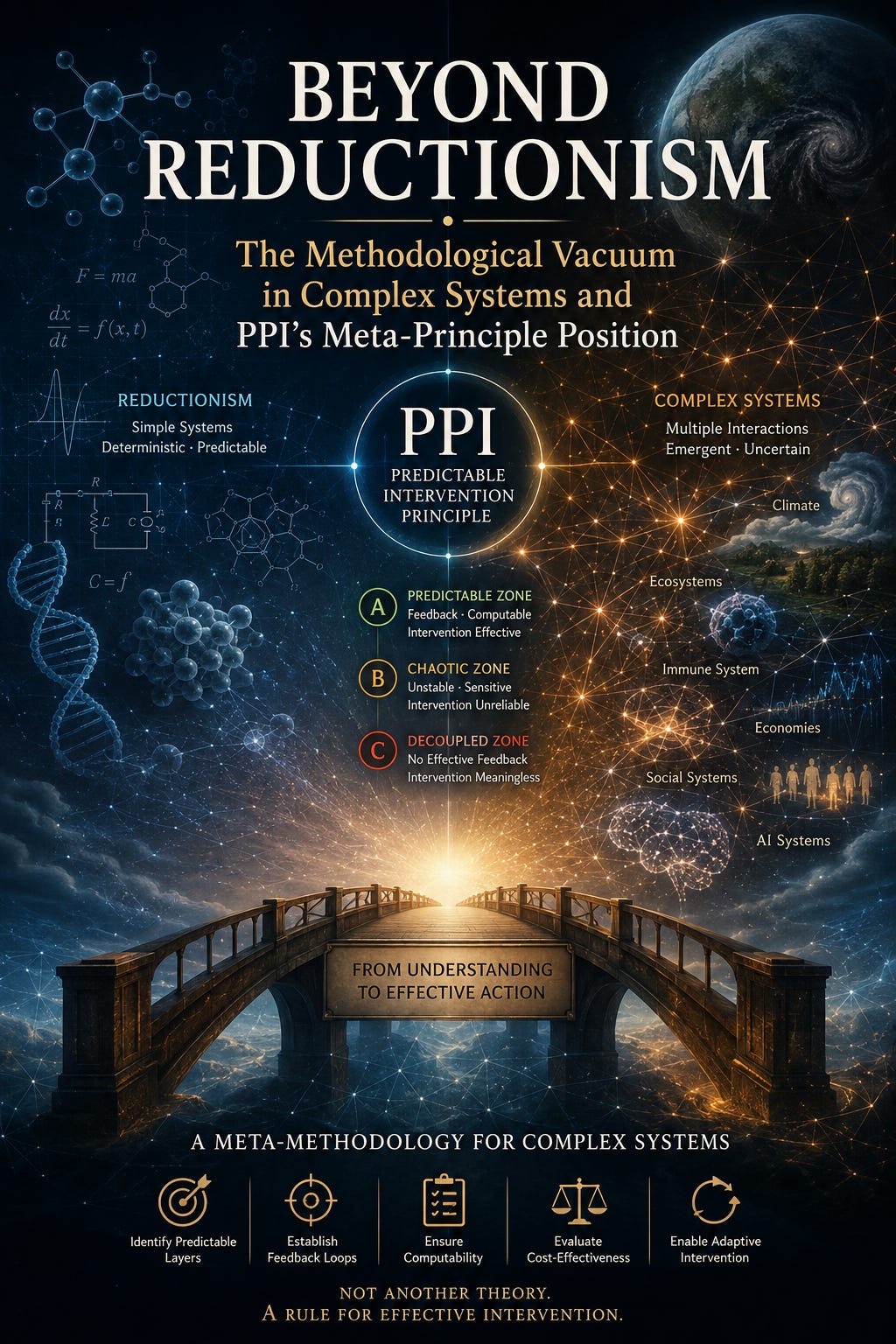
PPI, the Principle of Predictable Intervention, is the meta-methodology proposed to fill this vacancy.
Its core proposition is extremely simple:
Intervention is truly effective only at the level where the outcome can be stably predicted.
PPI divides the intervention space of complex systems into three zones.
Zone A: the predictable layer.
There is a feedback loop, the outcome can be stably predicted, and intervention is effective.
Zone B: the chaotic layer.
Feedback is unstable, variables are too numerous, outcomes easily diverge, and intervention often fails.
Zone C: the decoupled layer.
There is no effective feedback. Intervention is disconnected from outcome, and therefore meaningless.
Zone A does not simply mean “fewer parameters” or “something that looks deterministic.” The complete criteria for Zone A contain three necessary conditions.
Condition 1: theoretical computability.
The relationships among core parameters can be described by deterministic equations or high-confidence statistical laws. Given known inputs, outputs can be predicted.
Condition 2: practical computability.
Theoretical computability must be executable under real physical constraints, including time, computing power, measurement precision, data availability, operational conditions, and intervention windows.
A problem that requires searching an enormous state space may be theoretically computable, but practically incomputable. Such a problem is not Zone A in the PPI sense.
Condition 3: reasonable cost.
Even if a path is theoretically computable and practically computable, if its cost is far higher than an alternative that achieves the same effect, it still does not constitute an effective intervention path.
The meaning of Zone A is not merely “can be done,” but “is worth doing.”
On this basis, PPI makes an important extension:
Predictable layers can not only be identified; they can also be constructed.
In natural complex systems — atmosphere, climate, human physiology, ecology, geology, celestial systems — predictable layers mainly arise from natural laws, such as gravity, planetary rotation, energy conservation, fluid mechanics, physiological structure, and ecological boundaries. Humans cannot arbitrarily create these layers. We can only identify, use, and adapt to them.
In such systems, PPI requires:
identifying the predictable layer.
In human-made complex systems — large language model systems, market institutions, administrative systems, financial systems, regulatory systems, diplomatic relations, industrial chain organizations — predictable layers are not entirely natural. They are constructed by human rules, organizational structures, institutional arrangements, goal settings, and feedback mechanisms.
In such systems, PPI requires:
constructing the predictable layer.
There are three core conditions for constructing a predictable layer.
The objective function.
The system must know what it is trying to pursue. Without an objective function, the system runs without direction among multiple variables, interests, and paths, eventually entering a chaotic layer.
Boundary conditions.
The system must know what cannot be crossed. Boundary conditions prevent the system from sliding from a controllable state into an uncontrollable state.
Feedback mechanisms.
The system must be able to revise itself according to results. Without feedback mechanisms, objective functions and boundary conditions become static slogans.
Putting these together, the complete formulation of PPI is:
A complex system is not a mass of chaos, but a system with different layers. Effective intervention must select the layer where outcomes can be stably predicted, where a feedback loop can be formed, where the problem is theoretically computable, practically executable, and economically reasonable. For natural complex systems, the main task of humans is to identify naturally existing predictable layers. For human-coupled or human-made complex systems, humans can not only identify predictable layers, but also construct them through objective functions, boundary conditions, and feedback mechanisms.
This rule is structurally equal to reductionism.
Reductionism says:
Break the system down to the basic layer, establish determinacy there, and reconstruct from the bottom up.
PPI says:
Find the predictable layer, establish a feedback loop there, and constrain the system downward from Zone A.
Both are meta-rules. Both provide operational criteria. Both can be taught, tested, and diagnosed when they fail.
6. Engineering Realization: The Intratumoral Chlorine Dioxide Ablation System as an Anchor Point for PPI in Natural-System Identification
The legitimacy of any meta-methodology ultimately returns to engineering realization. The meta-methodological status of reductionism was established by three centuries of engineering victories, not by philosophical argument alone. If PPI is to stand beside reductionism at the level of meta-methodology, it also needs engineering realization as an anchor.
The intratumoral chlorine dioxide ablation system that I independently developed over fifteen years can be regarded as one engineering realization of PPI in the mode of identifying predictable layers within a natural complex system. The point here is not to discuss medical conclusions, but to discuss its methodological significance.
A solid tumor is a typical natural complex adaptive system: genetic mutations, protein expression, signaling pathways, immune escape, metabolic reprogramming, tumor microenvironment, angiogenesis, metastatic tendency — all of these are coupled across multiple nonlinear layers. The variables are numerous, the feedback chains are long, individual differences are large, and long-term evolution cannot be strictly predicted.
The mainstream biomedical approach to this system is largely the implementation of reductionist thinking: identify molecular targets, block signaling pathways, activate or modulate immune checkpoints, and design specific drugs. This path has achieved important progress in some cancer types, but for most solid tumors, its long-term output remains limited.
From the perspective of PPI’s layer judgment, many molecular layers in complex tumor systems belong to Zone B, or even Zone C. Their feedback is unstable, compensatory pathways are numerous, individual differences are large, and they often do not form a stable feedback loop with final observable clinical outcomes.
If a solid tumor is re-understood as a localized organic structure existing in physical space, rather than merely as a collection of molecular events, its predictable layers begin to emerge:
the physical structure of the tumor;
solid volume, boundary, and density;
the supporting microvascular network;
the spatial boundary of reaction and necrosis;
image-detectable structural changes;
the structural evolution trajectory across repeated treatments.
These layers are closer to Zone A in the PPI sense. They are not completely simple, but they are observable, measurable, feedback-generating, and correctable. They can form an intervention loop.
Under this logic, the intratumoral chlorine dioxide ablation system does not enter the tumor problem through the molecular-target layer. It enters through the spatial-structure layer, local-reaction layer, supporting microvascular layer, and imaging-feedback layer of the solid tumor.
Its methodological core is not to chase a molecular target, but to identify a more predictable physical-structural layer within the complex tumor system and establish a feedback loop at that layer.
Several key engineering properties of this system can be understood as manifestations of PPI discipline.
Self-limiting reaction.
The reaction stops automatically after being consumed at the local interface. This embeds boundary conditions into the physical process itself, rather than relying entirely on external control.
Dual action.
The system acts on both tumor tissue and the supporting microvascular network, avoiding the possibility that a single molecular mechanism is bypassed by compensatory pathways in the complex system, while vascular collapse creates structural amplification.
No cumulative toxicity.
This allows the “intervention-observation-reintervention” feedback chain to continue operating.
No significant inflammatory edema.
This reduces Zone B noise in the intervention region and makes imaging feedback clearer.
Non-single-coverage design.
Through repeated localization, observation, and correction, treatment becomes a cross-session feedback loop, rather than a one-time, uncorrectable operation.
Rapid visual feedback.
Through imaging or visually observable local changes, the Zone A feedback loop can close more quickly.
These features are not isolated technical characteristics. They are concrete engineering realizations of PPI methodology.
So far, this system has formed a body of preclinical research, human observational cases, veterinary cases, a patent framework, and ongoing regulatory pathways in both China and the United States. This article does not attempt to argue medical efficacy here. It only emphasizes the methodological meaning:
The system does not enter the complex tumor system through the most unpredictable molecular layer. Instead, it identifies more predictable layers — the physical spatial structure, microvascular support, local reaction boundary, and imaging feedback layer — and establishes a Zone A intervention system that is observable, feedback-generating, and repeatedly correctable.
This is the engineering anchor point of PPI in the identification mode of natural complex systems.
It does not prove that reductionism is invalid. Reductionism remains irreplaceable within its proper domain. What it proves is that, in some complex-system problems, if the mainstream reductionist path has long struggled to produce stable results, then re-identifying the predictable layer of the system and building a feedback loop around that layer may form another effective engineering path.
Every meta-methodology requires engineering realization to anchor its legitimacy. The intratumoral chlorine dioxide ablation system is one engineering anchor of PPI in natural-system identification. The realization of PPI in other natural complex systems — climate, ecology, neurobehavioral systems — and in human-made complex systems such as AI alignment, economic governance, and diplomatic relations, is the next task to be developed.
7. Conclusion
PPI does not seek to replace the epistemology of complex systems. Chaos theory, dissipative structures, synergetics, network science, complex adaptive systems, and other fields remain indispensable resources for describing and understanding complex systems.
PPI also does not seek to negate reductionism. In simple-system problems, and in subproblems that can legitimately be reduced to simple systems, reductionism remains the most effective methodology.
What PPI seeks to do is fill a long-standing vacancy: at the level of meta-methodology, it stands beside reductionism and specifically addresses complex-system problems.
Reductionism used three centuries of practice to prove itself as the meta-methodology of the simple-system era. Whether PPI can prove itself as the meta-methodology of the complex-system era will depend on continuous engineering tests across medicine, artificial intelligence, economic governance, geopolitics, ecology, and other fields.
The intratumoral chlorine dioxide ablation system provides one engineering anchor. The next step is to bring the same methodological discipline into other fields and subject it to the same kind of engineering test.
Reductionism solves the problem of deterministic construction in simple systems.
PPI solves the problem of effective action location in complex systems.
The position of the meta-rule has now been identified. Before PPI, this position was empty. It is no longer empty.
This is the true position of PPI in the history of scientific methodology. It does not depend on any authority, institution, or rhetorical occupation. It depends on only one thing:
When facing complex-system problems, does humanity need a set of operational rules that can stand beside reductionism?
The answer is obvious.
What remains is verification.
Any chance you can do a follow up on chlorine Dioxide for Hair growth? With more real life examples of people growing there hair bac etc.🙏