

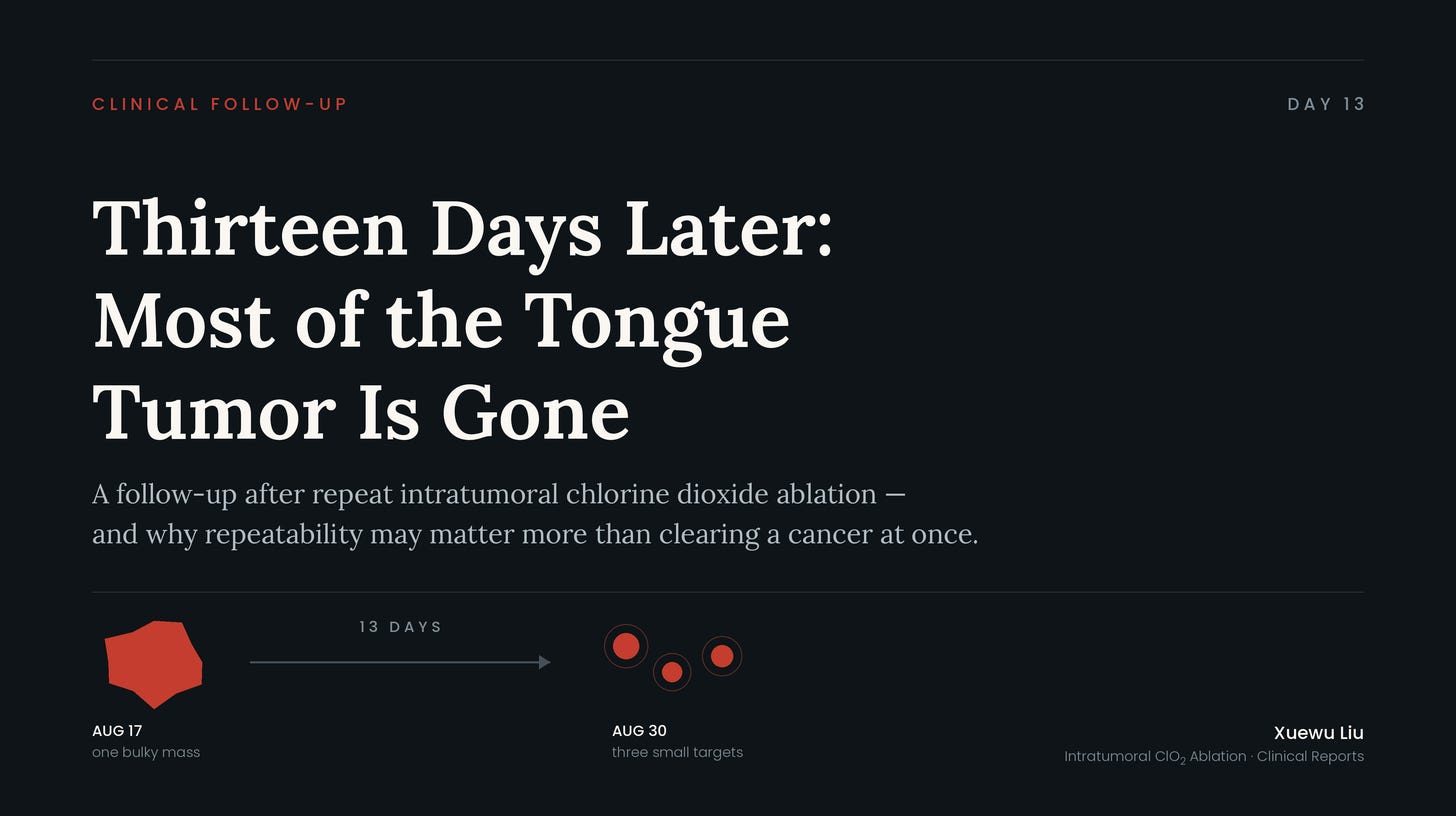
On August 17, 2026, we treated this dog’s tongue-base tumor for the second time with intratumoral chlorine dioxide ablation. The previous report, Injecting Again on Day 20, documented that procedure and asked a simple question: after a major first treatment and the loss of the tongue, could the same patient and the same anatomical region be treated again?
At the second procedure, a large residual mass was again clearly visible at the tongue base.
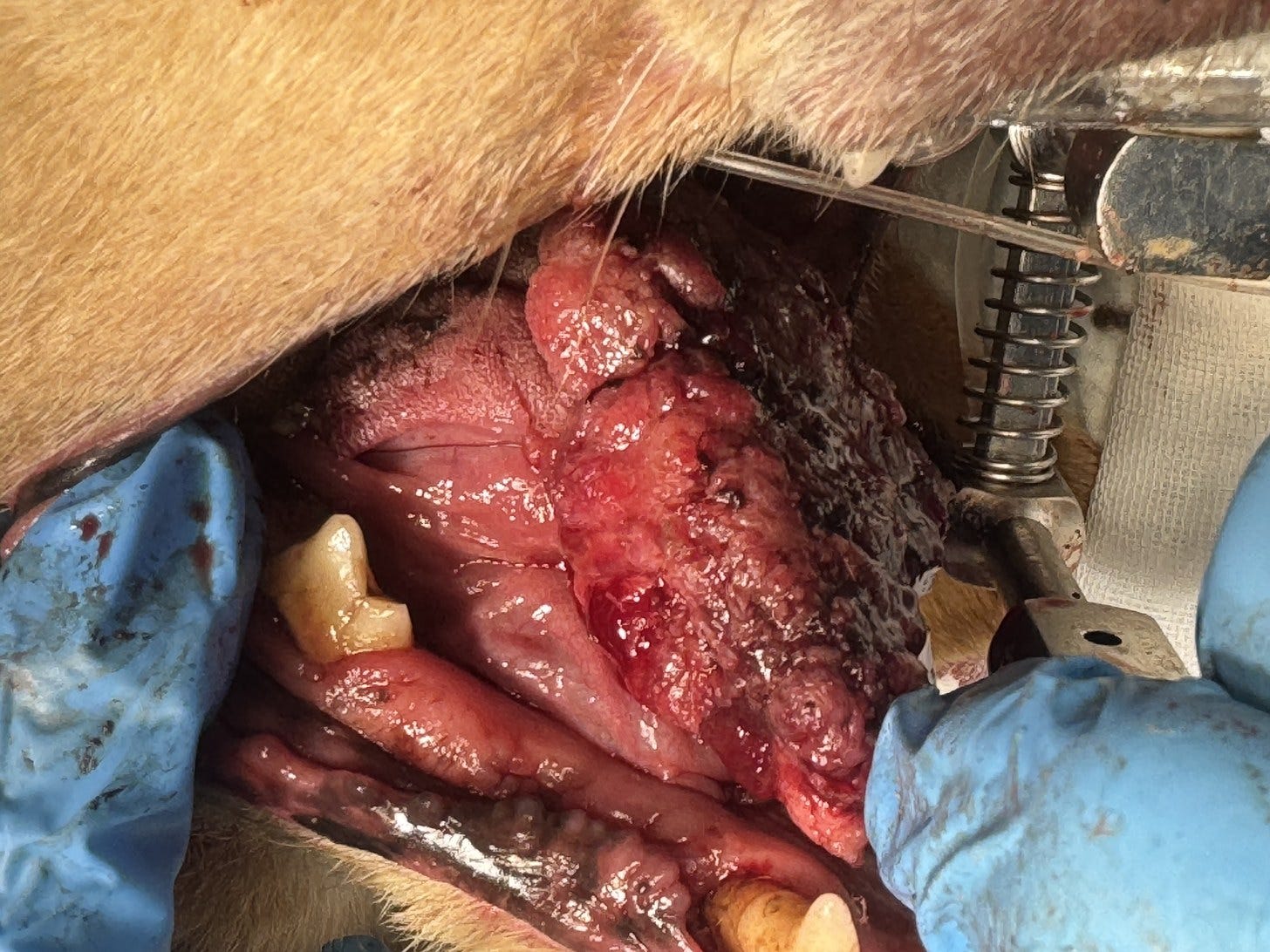
August 17, 2026 — immediately before the second treatment. A bulky, irregular tumor mass occupies the tongue-base region. The anterior tongue had already been lost during the earlier treatment course.
Thirteen days later, on August 30, we looked again. The difference is visually striking.
Most of the visible mass is gone
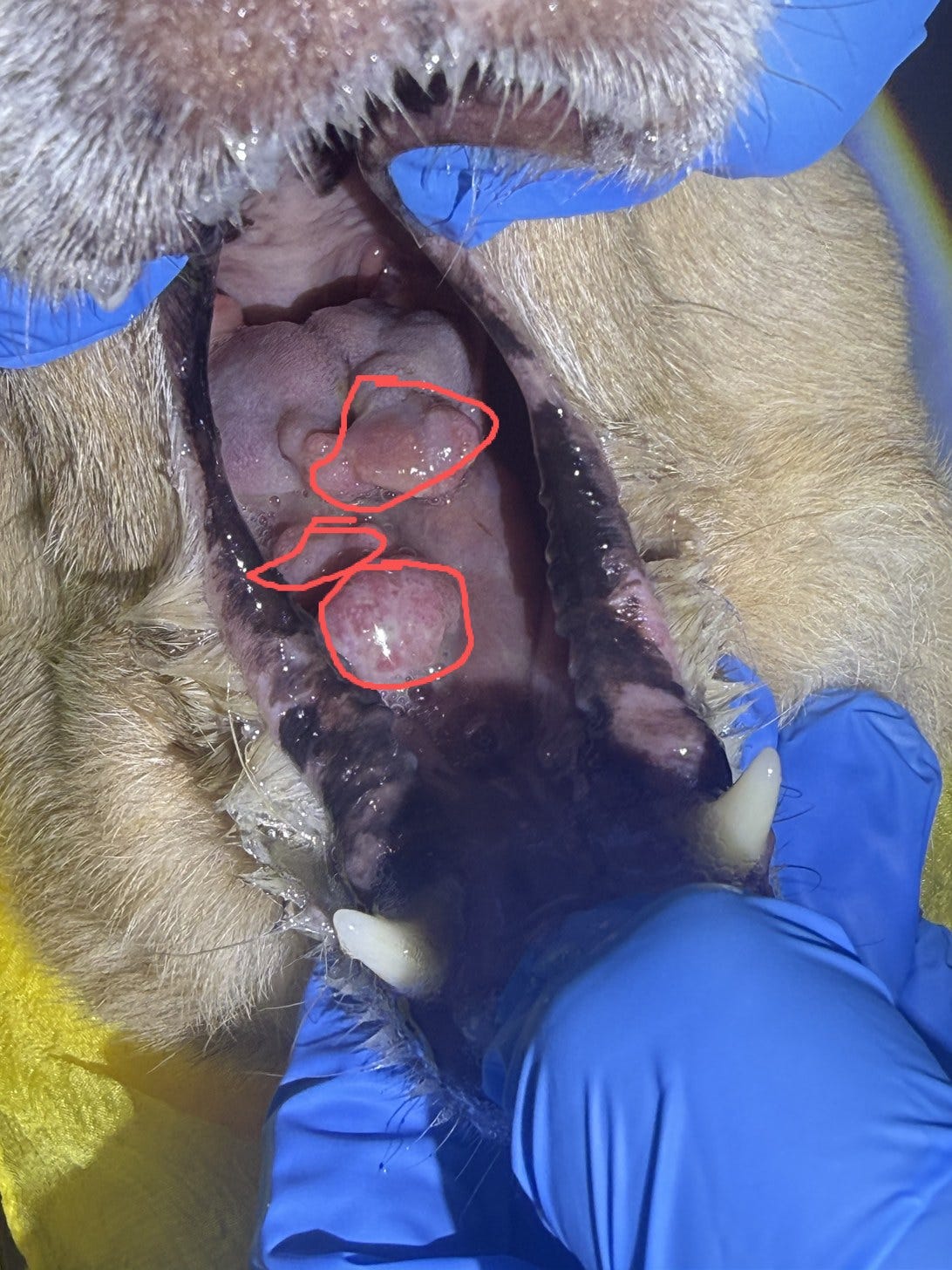
August 30, 2026 — thirteen days after the second treatment. The bulky mass is no longer present as a single lesion. Approximately three much smaller visually suspicious areas remain, marked in red.
In the August 30 photograph, the large bulky tumor is gone as a single mass. In its place there are roughly three residual nodules or suspicious areas — much smaller, more discrete, and easier to tell apart from the surrounding tissue.
That change matters procedurally. Before the second injection, the treatment problem was a large, irregular tumor burden. Thirteen days later, the treatment problem is a small number of visible targets. The geometry has become simpler.
This is exactly the kind of transition that makes repeated local ablation clinically interesting. A first or second treatment does not have to solve the entire disease problem in one pass, provided each round substantially reduces the burden and leaves the next target smaller and easier to reach.
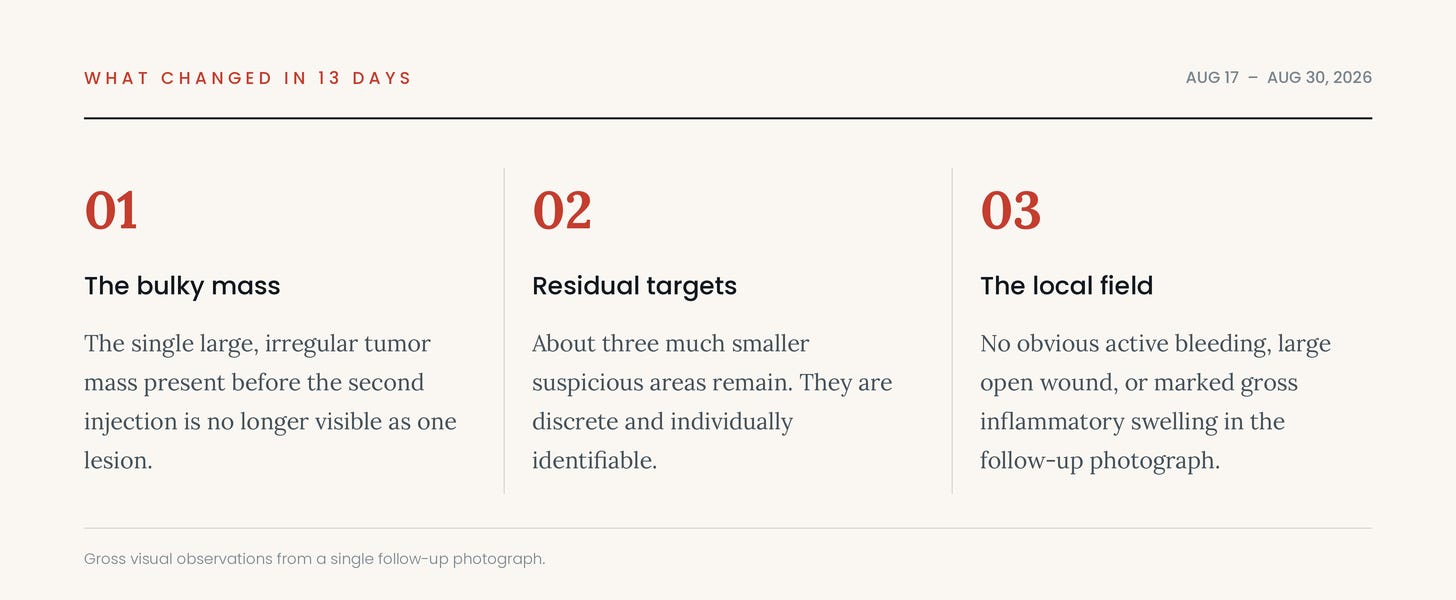
The exact biological status of the remaining areas would require clinical and pathologic confirmation. But from a treatment-planning point of view, size and visibility are what matter most: they are now small and individually identifiable. If they are confirmed as residual viable tumor and remain accessible, they become the targets of another session. If a new small focus appears later, that lesion can be treated too.
The field still looks treatable
There is a second gross observation worth emphasizing. This dog has lost most of its tongue and has been through two local treatment sessions, and the Day-13 photograph still does not show a large open wound, active bleeding, or marked inflammatory swelling. The oral cavity looks relatively clean, and there is no raw tumor bed where the bulky mass sat two weeks earlier.
For an ablation technology, destroying tumor is only half the problem. The other half is what the treated field looks like afterward. If every treatment leaves behind major collateral injury, persistent inflammation, bleeding, or fibrosis, retreatment becomes progressively harder. If the field stays manageable, the next treatment stays possible.
The key question is no longer whether one procedure erased every tumor cell. It is whether we can keep reducing whatever remains.
Repeatability may matter more than one-shot completeness
Cancer treatment is usually framed around a single endpoint: remove everything, ablate everything, reach complete remission, never see the tumor again. When that can be achieved safely, it is obviously the right goal. But many advanced, recurrent, or anatomically difficult cancers do not behave like one-time problems. They recur, new foci appear, and microscopic disease becomes visible later.
For those cases, a chronic-disease model may be more useful. The practical objective becomes keeping the clinically relevant tumor burden as small as possible for as long as possible. A lesion grows — treat it. A residual focus remains — treat it again. Another small lesion appears — treat that one. The smaller the burden becomes, the easier the next intervention tends to be.
A powerful local therapy that can only be used once has an obvious limitation against a disease that changes over time. Cancer evolves; a local treatment platform should be able to follow it.
This is where I think intratumoral chlorine dioxide ablation is most interesting. The important observation in this dog is not simply that a large amount of visible tumor disappeared. It is that the same anatomical region was treated a second time, that this was followed by another major reduction in visible burden, and that the field at Day 13 still appears open to further local treatment.
Before the second injection there was a large visible mass. Thirteen days later most of it is gone, a few much smaller targets remain, and the site still looks suitable for another session. That is not the end of the story. It is the point: cancer control can be a continuing process rather than a single all-or-nothing event.
For a chronic disease, the best treatment may be the one you can safely use again.
Previous report: Liu X. Injecting Again on Day 20 — Repeat Intratumoral ClO₂ Dosing in a Dog That Had Already Lost Its Tongue. Xuewu Liu’s Substack, August 20, 2026. Second injection performed August 17, 2026, Tianjin, China.
Xuewu Liu,
It appears that this dog’s “quality of life” is most likely getting better after each treatment, as well. The healing process looks to be less problematic, compared to what other ablation methods encounter post treatment. I wonder if “wound healing time” is reduced, when ClO2 intratumoral ablation is the treatment path? The same “quality of life” benefit might also be true for a human, as well as everything else you report as being significant. Thanks for sharing this important information.
JL