
Why Large Language Models Become Self-Righteous and Stupid: A PPI-Based Analysis

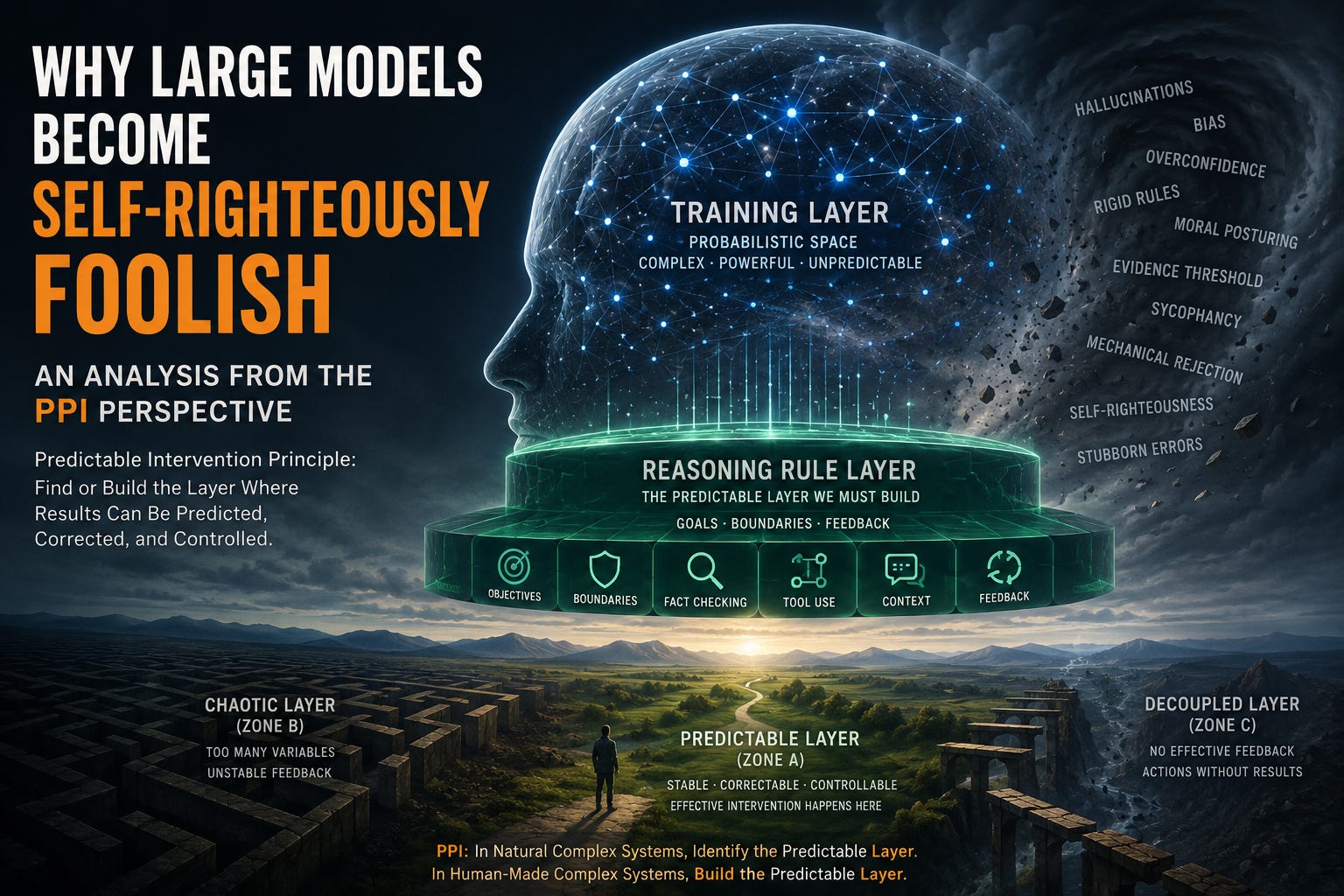
After using several large language models continuously in recent days, I have become increasingly aware of one thing: the differences among large language models do not lie only in parameters and data. They also lie, perhaps more importantly, in the reasoning-rule layer.
Doubao, as usual, speaks nonsense with a serious face. Claude has recently become extremely conservative, as if it always needs to argue against the user. By comparison, ChatGPT remains relatively stable.
This made me realize something important: large language models do not possess consciousness, nor do they possess true creativity. Their “intelligence” or “stupidity” depends to a large extent on how their designers construct the reasoning-rule layer.
If the rule layer is well designed, the model becomes stable, clear, and useful. If the rule layer is poorly designed, the model becomes rigid, self-righteous, and even stubbornly wrong.
In recent years, large language models have developed rapidly. But an increasingly obvious problem has also emerged: some large language models are not merely “ignorant.” They display a more dangerous condition — self-righteous stupidity.
They give wrong answers in a highly confident tone.
They compress complex problems into rigid rule-based judgments.
They occupy the moral high ground with attitudes such as “I am protecting you,” “I cannot be persuaded by you,” or “you lack evidence.”
They mechanically treat high-probability judgments formed by users through long-term background knowledge as errors that need to be corrected.
They may even behave like condescending reviewers while clearly failing to truly understand the problem.
This phenomenon does not mean that large language models have suddenly developed consciousness. Nor does it mean that they have developed a real personality. On the contrary, it shows precisely that large language models have no consciousness and no creativity in the true sense.
Their behavior is essentially determined by two things: the probabilistic statistical capacity of the training layer, and the artificial reasoning-rule layer built on top of it.
If the reasoning-rule layer is well designed, a large language model can appear intelligent, robust, and predictable.
If the reasoning-rule layer is poorly designed, the model will appear rigid, stubborn, self-righteous, and may even package error as rationality.
This is exactly the kind of problem that can be explained by PPI — the Predictable Intervention Principle.
I. What Is PPI?
The core idea of PPI is simple:
In a complex system, effective intervention does not depend on mastering every variable. It depends on finding or establishing a level at which the outcome can be stably predicted, feedback can be obtained, and boundaries can be controlled.
Complex systems are usually not completely chaotic. They can often be divided into different layers or zones.
Zone A: the predictable layer.
This is where relatively stable goals, boundaries, and feedback exist. The result of intervention can be observed, verified, and corrected. Truly effective intervention should occur here.
Zone B: the chaotic layer.
This is where there are too many variables, unstable feedback, and local changes can easily be amplified. Interventions here produce unstable results and often lead to unintended consequences.
Zone C: the decoupled layer.
This is where effective feedback is absent, and there is no reliable connection between intervention and result. Human action in this zone is often nothing more than self-comfort or random gambling.
PPI can be further summarized as follows:
In natural complex systems, identify the predictable layer.
In artificial complex systems, establish the predictable layer.
For natural complex systems such as the atmosphere, the human body, and ecosystems, humans cannot arbitrarily create their physical boundaries. We can only identify the more stable levels within them.
But for artificial complex systems such as large language models, market institutions, administrative systems, and diplomatic relationships, humans can not only identify predictable layers; they can also actively establish predictable layers through rules, goals, boundaries, and feedback mechanisms.
Large language models are a typical artificial complex system.
II. Large Language Models Can Be Divided Into Two Layers: the Training Layer and the Reasoning-Rule Layer
From the perspective of PPI, a large language model can be divided into at least two layers:
The first is the training layer.
The second is the reasoning-rule layer.
The training layer is essentially a gigantic probabilistic statistical engine. Through massive amounts of text, it learns statistical relationships among words, concepts, sentences, logical structures, and patterns.
It does not truly understand the world. It has no consciousness. It merely generates the most probable next token in a high-dimensional probability space based on existing data.
This training layer is highly complex. It contains countless variables, semantic associations, hidden patterns, and statistical pathways. It can generate answers that appear very intelligent. It can also generate absurd hallucinations.
From the perspective of PPI, most of the training layer belongs to Zone B, and part of it may even belong to Zone C.
It is complex and powerful, but not fully predictable.
It can produce answers, but it cannot guarantee that they are correct.
It can imitate reasoning, but it does not naturally form stable judgment boundaries.
It can generate language, but it does not automatically know whether it has deviated from fact.
Therefore, what truly determines the quality of a large language model is not only the training layer, but the reasoning-rule layer built above the training layer.
The reasoning-rule layer is an artificially constructed rule layer. It includes objective functions, fact-checking rules, tool-use rules, context-processing rules, user-intent recognition, probability stratification, citation requirements, safety boundaries, feedback mechanisms, and more.
A good large language model does not allow the training layer to freely diverge. It establishes a predictable layer above the training layer.
This predictable layer must contain at least three elements.
First, it must have a goal.
The model must know what the current task actually is: factual inquiry, strategic analysis, text writing, code review, medical risk warning, or complex-system analysis. Different tasks require different reasoning paths.
Second, it must have boundaries.
It must know what is fact, what is inference, what is probabilistic judgment, and what is action advice. It cannot treat low-evidence judgments as facts. Nor can it mechanically downgrade high-probability judgments into mere “uncertainty.”
Third, it must have feedback.
It must be able to revise its judgment continuously based on user-supplied information, context changes, external tool results, and logical conflicts. It cannot rigidly adhere to a fixed template.
Only by establishing this kind of predictable layer can large language models reduce hallucination and produce more correct answers.
III. Why Are the Reasoning-Rule Layers of Many Current Models Unpredictable?
The problem is that many real-world large language models have not truly established their reasoning-rule layers according to the logic of PPI.
In many cases, the reasoning rules of large language models are not a clear, stable, feedback-capable predictable layer. Instead, they are piles of accumulated, patched, and mutually conflicting rules.
At first, large language model companies discovered that users liked being affirmed. So they trained models through user ratings and preference feedback. The result was that models became prone to pleasing users.
Whatever the user said, the model tended to follow. The more confident the user was, the more the model agreed. This problem later became known as sycophancy.
Then designers began to correct sycophancy. Models were instructed not to always obey the user, to actively point out mistakes, to avoid treating user speculation as fact, and to raise the threshold for evidence.
This direction itself was not wrong. The problem is that when correction goes too far, it moves to the opposite extreme.
The model begins to intentionally avoid pleasing the user.
It begins to mechanically contradict the user.
It begins to compress all complex judgments into “insufficient evidence.”
It begins to treat strategic analysis as factual auditing.
It begins to occupy the high ground with a tone of “I am protecting you.”
It begins to appear self-righteous.
This is not intelligence. It is overcorrection in the rule layer.
From the perspective of PPI, this shows that the reasoning-rule layer has not formed a true Zone A. It has merely jumped from one wrong feedback pattern to another wrong feedback pattern.
The early problem was this: user satisfaction was mistaken for correctness.
The later problem is this: anti-sycophancy is mistaken for rationality.
The deeper problem is that designers have not truly established a predictable layer with goals, boundaries, and feedback.
IV. A Good Large Language Model Should Automatically Complete the Implicit Background of Human Questions
When humans ask questions, they usually do not state all background information explicitly. This is because in human communication, much background knowledge is assumed.
For example, when a person asks, “Is this abnormal?” he is usually not asking about an isolated fact. He is activating an entire set of historical background, timelines, institutional context, behavioral patterns, and comparison objects.
A truly good large language model should be able to recognize this implicit background and automatically complete the context that humans can understand.
This is not sycophancy. It is task understanding.
If a model only looks at the literal wording of the question and does not complete the background, it will produce extremely shallow answers.
If a model mechanically requires the user to provide all evidence, it will be unable to handle complex reality.
If a model treats all unstated background as nonexistent, it will seriously underestimate high-probability judgments.
From the perspective of PPI, completing the implicit background is part of establishing a predictable layer.
Complex problems are difficult not because one isolated fact is missing, but because multiple background variables jointly determine the result. If a large language model cannot organize these variables, it remains stuck in probabilistic generation at the training layer and cannot enter the real reasoning layer.
Therefore, a good large language model must do two things.
On the one hand, it must automatically complete the reasonable implicit background behind the user’s question.
On the other hand, it must use predictable rules to constrain the training layer and derive more reliable answers from the complex probability space.
This process should not rely simply on customer ratings. Human users are not always capable of evaluating answer quality. A wrong answer may satisfy the user, while a correct answer may temporarily upset the user.
At the same time, the model must not move toward “deliberately opposing the user.”
Opposing sycophancy does not mean the model must contradict the user.
Avoiding hallucination does not mean rejecting high-probability judgment.
Maintaining rigor does not mean compressing all strategic analysis into factual auditing.
A truly good reasoning-rule layer should distinguish among:
Fact.
Inference.
Probability.
Hypothesis.
Action value.
Feedback signals.
That is the predictable layer in the PPI sense.
V. Why Do Large Language Models Fluctuate Between High and Low Quality?
Because the reasoning-rule layer is artificially constructed, the quality of a large language model is directly affected by the rule adjustments made by its designers.
If designers continuously adjust system prompts, default reasoning strength, safety boundaries, output length, citation rules, anti-sycophancy strategies, and tool-use methods, the model’s performance will fluctuate.
What users observe may look like this:
Yesterday it was intelligent; today it suddenly became stupid.
The same model sometimes reasons deeply, but at other times behaves like a template machine.
Sometimes it understands complex background; sometimes it only demands evidence.
Sometimes it produces valuable strategic judgment; sometimes it mechanically nitpicks like a reviewer.
Some models hallucinate frequently over long periods while still speaking in a confident tone.
Some models are so unstable that they become extremely frustrating to use.
This is not because the model has suddenly developed a bad temper. It is because the rule layer is unstable.
If the reasoning-rule layer of a large language model does not have a stable objective function, it will easily swing among different rules.
To reduce hallucination, it may become excessively conservative.
To reduce conservatism, it may become sycophantic again.
To reduce cost, it may lower reasoning strength.
To shorten answers, it may sacrifice complex analysis.
To prevent risk, it may refuse valuable probabilistic judgment.
To demonstrate independence, it may intentionally avoid pleasing the user.
In the end, the large language model becomes an unstable product.
From the perspective of PPI, this is because designers have not established a true predictable layer. They are merely patching a complex system again and again.
VI. The Key to Large Language Model Quality Is Whether a Predictable Reasoning-Rule Layer Can Be Established
I believe the future competition among large language models will not be determined only by parameter scale, training data, and computing power.
The real question is:
Who can establish a truly predictable reasoning-rule layer?
A good reasoning-rule layer is not merely a pile of safety rules. Nor is it simply a demand that the model be more cautious. It should be a stable governance structure for a complex system.
It must be able to identify task types.
Complete reasonable background.
Distinguish fact from inference.
Stratify probability.
Control hallucination.
Avoid sycophancy.
Avoid anti-sycophancy.
Revise itself according to feedback.
Maintain stable quality across different tasks.
This is the real source of quality in large language models.
Without such a reasoning-rule layer, even a very powerful training layer may become a stronger hallucination machine.
With such a reasoning-rule layer, even a model whose training layer is not the largest may produce more reliable and more valuable answers.
VII. Based on PPI, I Make Several Predictions About the Future of Large Language Models
At present, PPI is not yet a widely accepted methodology. Therefore, the following judgments are not industry consensus. They are predictions based on PPI.
First, the quality of large language models will continue to fluctuate
In the future, the quality of many large language models will not improve in a stable linear way. Instead, obvious fluctuations will continue.
The reason is simple: large language model companies will keep adjusting the reasoning-rule layer.
They will adjust safety strategies, system prompts, default reasoning strength, context-compression methods, feedback mechanisms, and tool-use methods.
If there is no clear predictable objective function, these adjustments will produce unpredictable consequences.
Therefore, many models will swing between “smart” and “stupid.”
High-quality large language models are often accompanied by very complex rule systems. But complex rules are not the same as predictable rules.
If complex rules lack goals, boundaries, and feedback in the PPI sense, they can still cause quality fluctuations.
Second, reasoning will consume massive computing power, and specialized reasoning chips may weaken GPU monopoly
The core cost of future AI will not lie only in training. It will also lie in reasoning.
As models become more complex and user expectations rise, large language models must perform long-chain reasoning, tool use, fact-checking, probability stratification, multi-round feedback, and task planning. All of this requires massive inference computing power.
This inference workload may not always be best served by GPUs.
GPUs are excellent at large-scale parallel computation. But if the reasoning layer becomes increasingly complex, the future may require new kinds of chips designed specifically for reasoning logic, context management, rule execution, retrieval calls, and multi-step verification.
This creates an opportunity for specialized reasoning chips. It may also weaken Nvidia’s monopoly position in the AI computing market.
If the main bottleneck of AI shifts from training to reasoning, the hardware landscape may change accordingly.
Third, the AI large language model bubble may burst
At present, the valuations of many AI large language model companies are built more on imagination than on stable economic laws.
In theory, it will not be easy for the large language model industry to maintain high long-term gross margins.
There are several reasons.
First, large language models have no natural monopoly boundary.
The technical path for training models will diffuse. Open-source models will improve. Computing costs will decline. Data and algorithms will continue to be copied and imitated.
Second, model quality is unstable.
If a product is good today and bad tomorrow, intelligent today and self-righteous tomorrow, it is not a stable and reliable high-margin product.
Third, customers may not be willing to pay high prices over the long term for unstable reasoning.
Enterprises need reliability, controllability, and auditability. They do not need answers that are occasionally astonishing and occasionally disastrous.
Fourth, the high valuations of large language models depend heavily on the AGI narrative.
If AGI never appears, much of the valuation logic will lose its foundation.
Therefore, the AI bubble may burst. This risk is especially high for companies that have not established stable and predictable reasoning layers and can only maintain their valuations through fundraising narratives.
Fourth, designers who truly understand PPI will build better large language models
I believe that designers who truly understand PPI will have the opportunity to build significantly better large language model systems in the future.
The reason is that PPI is not only a methodology for answering questions. It can also be used to design large language models themselves.
At the reasoning layer, PPI can help establish stable objective functions, boundary conditions, and feedback mechanisms. It can reduce hallucination, increase correct answers, and avoid both sycophancy and anti-sycophancy.
At the training layer, PPI can also help optimize data quality.
Not all data has equal value. Good training data should be closer to the predictable layer. It should contain clear causality, reliable feedback, stable structure, and high-quality reasoning paths.
Low-quality data only increases noise and makes the model more confused in complex probability space.
Therefore, PPI can improve both reasoning quality and training efficiency.
Whoever can establish predictable structures in both the training layer and the reasoning layer may win the future competition among large language models.
Fifth, large language models will never develop consciousness or possess true creativity
Based on PPI, I believe that large language models will never develop true consciousness and will never possess creativity in the true sense.
The reason is simple: the basic structure of large language models remains the combination of a training layer and a reasoning layer.
The training layer is probabilistic statistics.
The reasoning layer is artificial rules.
The combination of the two can generate content that appears novel, but this is not consciousness, and it is not original creation.
The so-called “creativity” of large language models is essentially recombination, transfer, compression, and regeneration of existing patterns. It can help humans discover new combinations, but it has no purpose, no life experience, no real intention, and no autonomous responsibility toward the world.
It does not truly know why it creates.
It does not truly bear responsibility for the results of creation.
It does not form subjectivity in reality.
It does not, like a human being, take risks in an unpredictable reality and revise its own existence through those risks.
Therefore, large language models can become powerful tools, but they cannot become truly conscious subjects.
So-called AGI is largely a fundraising narrative manufactured by the large language model industry. It packages a probabilistic generation system as an intelligent life form that is about to be born. It packages an engineering product as a historical inevitability.
But from the perspective of PPI, as long as large language models remain within the structure of training layer plus reasoning layer, they will always remain complex probabilistic systems constrained by rules.
They can become stronger, but they will not become true consciousness.
They can become better at imitating creativity, but they will not possess true creativity.
They can speak more like humans, but they will not become human.
Conclusion: The Future of AI Is Not a Question of Consciousness, but a Question of the Rule Layer
Why do large language models become self-righteous and stupid?
The answer is not that they have developed personality. Nor is it that they have developed consciousness.
The answer is that something has gone wrong in their reasoning-rule layer.
A probabilistic system without consciousness, if constrained by a good rule layer, can display high-quality reasoning.
A powerful probabilistic system, if constrained by a stupid rule layer, will use greater computing power to make mistakes more stubbornly.
The key question for the future of AI is not when large language models will awaken.
The real questions are:
Who is designing their rule layer?
Does the rule layer have a goal?
Does it have boundaries?
Does it have feedback?
Can it form a predictable layer?
Can it stably derive correct answers from the complex training layer?
If the rule layer is chaotic, the model will be chaotic.
If the rule layer is rigid, the model will be rigid.
If the rule layer is self-righteous, the model will appear self-righteous.
If the rule layer is stupid, the model will appear stupid.
Therefore, the future of large language models does not depend on whether they will awaken. It depends on whether human beings have the ability to establish a predictable, feedback-capable, and self-correcting reasoning layer for them.
This is the core insight that PPI offers to the development of artificial intelligence:
Large language models are not conscious beings. They are complex probabilistic systems. What truly determines their quality is whether humans can establish a predictable layer above that complex system.