
Brain–Computer Interfaces and Humanoid Robots Through the PPI Lens: Why They Look Explosive, Yet Their Ceiling Is Low

Introduction: The Musk Effect and China’s Reflex to Copy Proven Engineering Miracles
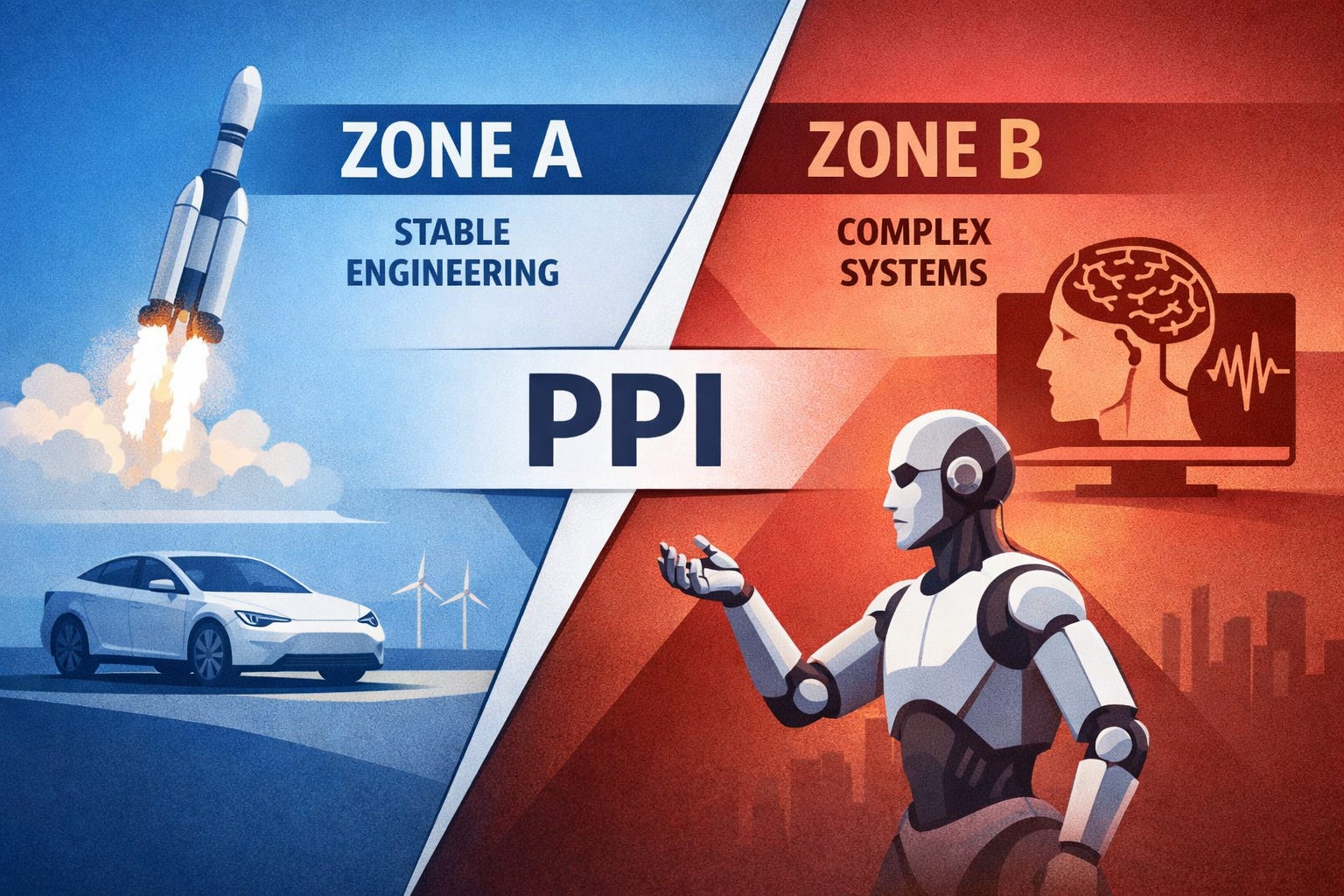
Elon Musk’s two most successful industrial stories over the past decade—reusable rockets and electric vehicles—triggered two familiar waves of imitation in China. The reason is straightforward: both domains follow a textbook engineering trajectory. Goals are clear, metrics are measurable, feedback loops are stable, and iteration reliably compounds. Invest more, iterate faster, reduce cost, improve reliability—results converge with high predictability. Capital, industry, and government learned the same instinct: if you get the engineering right and scale hard enough, victory emerges like an assembly line.
Because that pattern was so compelling, when Musk placed major bets on humanoid robots and brain–computer interfaces (BCI), many people simply extended the same mental model: these, too, would follow the “rapid engineering → mass production → exponential adoption” curve. China’s market responded with the same posture—treating both as the next inevitable industrial revolution, assuming that following the leader is enough to reproduce success.
But this is precisely where a structural misread happens:
Reusable rockets and EVs are predictable engineering problems.
BCIs and humanoid robots, in real-world deployment, are complex-system problems.
This is not a question of “harder” or “slower.” It’s a question of system class. In complex systems, feedback loops can diverge, not converge. As investment scales, loss-of-control risk and regulatory barriers can rise faster than performance improves—locking potential under a hard ceiling.
To see why, we need a framework stronger than “engineering intuition.” We need PPI.
1) PPI: Turning “Can We Build It?” Into a Structural Test
PPI—the Predictable Intervention Principle—divides problem spaces into three zones based on whether interventions can form a stable, convergent feedback loop.
Zone A: Predictable (Closed-Loop Convergence)
Feedback is observable, the loop is stable, and intervention improves outcomes reliably. More iteration brings more certainty. Scaling is replicable.
Zone B: Chaotic (Unstable or Divergent Feedback)
Feedback is unstable or drifting. Systems adapt, resist, or shift. You believe you are optimizing, but the target moves. Results become conditional and fragmented rather than universal.
Zone C: Decoupled (No Meaningful Feedback)
Either the feedback is not operationally measurable, or the goal itself is not engineering-definable. Interventions become narratives rather than roadmaps.
Musk’s “engineering miracles” largely succeeded by keeping the critical challenges in Zone A. BCIs and humanoid robots, however, are dominated by Zone B dynamics—especially in the applications people hype the most.
2) Why Rockets/EVs Are Zone A, While BCIs/Humanoids Aren’t
Reusable rockets and EVs: Stable industrial engineering
Goals are explicit (cost, reliability, thrust, range, energy efficiency, production yield).
Key variables are measurable and controllable (materials, structure, control systems, manufacturing processes).
Feedback cycles are fast (test flights, road tests, benches, lifecycle loops).
Failures are diagnosable and attributable (a valve, a weld, a software line).
That’s Zone A: iterate, improve, iterate again—and the system converges.
BCIs and humanoid robots: Forced coupling to complex systems
These domains aren’t merely “hard.” They are structurally coupled to complex, drifting environments:
BCIs couple to a biological system that remodels itself, drifts over time, and varies drastically between individuals.
Humanoid robots couple to the open-world long tail, human safety constraints, and social/legal accountability.
These couplings push the decisive parts of the system into Zone B: unstable feedback, conditional performance, and scaling friction.
3) PPI Analysis: Why BCIs Are Strictly Constrained
3.1 Zone A BCIs: Low-dimensional medical input loops
Under PPI, the most reliable BCI pathway is to compress the objective into Zone A: cursor control, click, typing, basic device control—essentially treating the brain as an input device.
Why this tends to stay in Zone A:
Output dimensionality is low; success is directly measurable (speed, error rate).
Individual calibration is acceptable; drift can be compensated through engineering.
Failure costs are manageable; responsibility boundaries are clearer.
So yes: BCIs will keep advancing in narrow medical needs. That’s real.
3.2 Zone B BCIs: High bandwidth, “semantic readout,” cross-user generalization
Once BCIs aim for “natural speech rates,” semantic decoding, emotion/memory readout, or cognitive enhancement, they drift into Zone B:
Signal drift: the substrate changes over time; convergence gets interrupted.
Individual variability: each brain is effectively a different system.
Unobservable state variables: attention, fatigue, medication, mood, plasticity.
Proxy-metric traps: short-term accuracy is not the same as long-term usability or stability.
Zone B doesn’t produce universal consumer products. It produces conditional, fragile, personalized solutions.
3.3 The extra risk in Zone B: Loss of control isn’t sci-fi—it’s structural
In Zone B, the primary cost is not “slow progress.” It’s divergence.
BCI loss-of-control risk often looks like:
Mistaking noise for intent: drift yields plausible outputs that are not the user’s true intention.
Responsibility collapse: the system claims “you intended this,” the user denies it—creating legal/medical accountability disasters.
Privacy and misuse surfaces expand exponentially: once you pursue semantic readout, the attack and abuse surface becomes the product.
PPI conclusion: the scalable BCI market is constrained to Zone A medical input. The more you pursue Zone B “enhancement” narratives, the more risk and regulation compress the ceiling.
4) PPI Analysis: Why Humanoid Robots Face an Even Harder Ceiling
4.1 Zone A humanoids: Automation in structured environments
Humanoids can be engineered into Zone A when environments are controlled (lighting, floors, pathways, standardized objects), tasks are explicit (carry, load, inspect), and safety boundaries can be hard-coded (speed, torque, isolation zones).
In these cases, iteration converges. But note what this implies: the robot is not “general labor.” It becomes a special-purpose machine wearing a humanoid body.
4.2 Zone B humanoids: Open-world general labor
The moment the objective becomes “do what humans do everywhere”—homes, streets, malls, construction sites—the system drops into Zone B:
Infinite long tail: unseen situations are guaranteed.
Semantic goals: “clean up” is not a stable objective function.
Heavy safety liability: one mistake becomes an injury.
Replication risk: one flawed policy can replicate across thousands of units simultaneously.
4.3 The extra risk in Zone B: Physical actuation converts errors into harm
Unlike software, a humanoid turns policy errors into physical outcomes. In Zone B, “smarter” does not automatically mean “safer.” A larger behavior space can amplify hazard.
Result: loss-of-control risk triggers insurance, legal, and regulatory hard barriers. Scaling becomes locked into small pilots rather than mass adoption.
PPI conclusion: the scalable market is Zone A structured automation. The hyped “general-purpose humanoid worker” is Zone B—and it gets capped by accountability.
5) Final Conclusion: PPI Forces Both Industries to Fold Their “Potential” Downward
Rockets and EVs succeeded because they are Zone A: stable feedback produces predictable scaling.
BCIs and humanoid robots are dominated, in their most hyped applications, by Zone B: unstable feedback, conditional performance, long-tail failure modes.
Loss-of-control risk is not a side issue. It’s a Zone B amplifier. It turns regulation, liability, insurance, and social acceptance into hard ceilings that compress scale.
So these industries are not limited by compute or hype. They are limited by PPI structure:
The parts that can scale must be compressed into Zone A.
The parts that are most hyped are largely in Zone B.
Therefore, they may look like infinite upside stories, but their potential is tightly constrained—and their ceiling is low.
Thank you for this thoughtful breakdown of BCI-tech through the lense of your PPI-approach! What do you think would the Integration of the dielectric nature of the entirety of Organic life add to your Argumentation? Since WWII Russia and Germany know, that electromagnetic fields interaktiv with the cells exposed. And Since Herman Schwan, a paperclip-scientist who in the 1970s became one of the founders of Biophysics, the world knows from him, how important exposure limits really are. Ignoring Natural laws is Part of the problem you are describing!